

keras 实现轻量级网络ShuffleNet教程
ShuffleNet是由旷世发表的一个计算效率极高的CNN架构,它是专门为计算能力非常有限的移动设备(例如,10-150 MFLOPs)而设计的。该结构利用组卷积和信道混洗两种新的运算方法,在保证计算精度的同时,大大降低了计算成本。ImageNet分类和MS COCO对象检测实验表明,在40 MFLOPs的计算预算下,ShuffleNet的性能优于其他结构,例如,在ImageNet分类任务上,ShuffleNet的top-1 error 7.8%比最近的MobileNet低。在基于arm的移动设备上,ShuffleNet比AlexNet实际加速了13倍,同时保持了相当的准确性。
Paper:ShuffleNet: An Extremely Efficient Convolutional Neural Network for Mobile
Github:https://github.com/zjn-ai/ShuffleNet-keras
网络架构
组卷积
组卷积其实早在AlexNet中就用过了,当时因为GPU的显存不足因而利用组卷积分配到两个GPU上训练。简单来讲,组卷积就是将输入特征图按照通道方向均分成多个大小一致的特征图,如下图所示左面是输入特征图右面是均分后的特征图,然后对得到的每一个特征图进行正常的卷积操作,最后将输出特征图按照通道方向拼接起来就可以了。
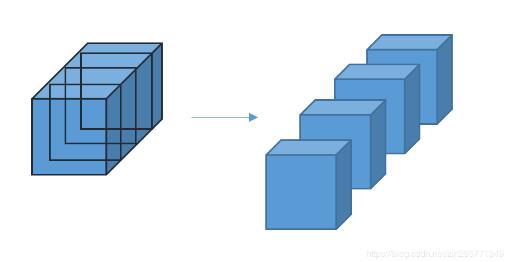
目前很多框架都支持组卷积,但是tensorflow真的不知道在想什么,到现在还是不支持组卷积,只能自己写,因此效率肯定不及其他框架原生支持的方法。组卷积层的代码编写思路就与上面所说的原理完全一致,代码如下。
def _group_conv(x, filters, kernel, stride, groups):
 """
 Group convolution
 # Arguments
  x: Tensor, input tensor of with `channels_last` or 'channels_first' data format
  filters: Integer, number of output channels
  kernel: An integer or tuple/list of 2 integers, specifying the
   width and height of the 2D convolution window.
  strides: An integer or tuple/list of 2 integers,
   specifying the strides of the convolution along the width and height.
   Can be a single integer to specify the same value for
   all spatial dimensions.
  groups: Integer, number of groups per channel

 # Returns
  Output tensor
 """
 channel_axis = 1 if K.image_data_format() == 'channels_first' else -1
 in_channels = K.int_shape(x)[channel_axis]

 # number of input channels per group
 nb_ig = in_channels // groups
 # number of output channels per group
 nb_og = filters // groups

 gc_list = []
 # Determine whether the number of filters is divisible by the number of groups
 assert filters % groups == 0

 for i in range(groups):
  if channel_axis == -1:
   x_group = Lambda(lambda z: z[:, :, :, i * nb_ig: (i + 1) * nb_ig])(x)
  else:
   x_group = Lambda(lambda z: z[:, i * nb_ig: (i + 1) * nb_ig, :, :])(x)
  gc_list.append(Conv2D(filters=nb_og, kernel_size=kernel, strides=stride,
        padding='same', use_bias=False)(x_group))

 return Concatenate(axis=channel_axis)(gc_list)
通道混洗
通道混洗是这篇paper的重点,尽管组卷积大量减少了计算量和参数,但是通道之间的信息交流也受到了限制因而模型精度肯定会受到影响,因此作者提出通道混洗,在不增加参数量和计算量的基础上加强通道之间的信息交流,如下图所示。
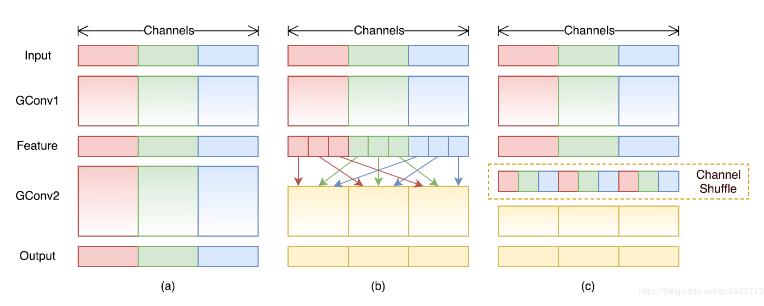
通道混洗层的代码实现很巧妙参考了别人的实现方法。通过下面的代码说明,d代表特征图的通道序号,x是经过通道混洗后的通道顺序。
>>> d = np.array([0,1,2,3,4,5,6,7,8])
>>> x = np.reshape(d, (3,3))
>>> x = np.transpose(x, [1,0]) # 转置
>>> x = np.reshape(x, (9,)) # 平铺
'[0 1 2 3 4 5 6 7 8] --> [0 3 6 1 4 7 2 5 8]'
利用keras后端实现代码:
def _channel_shuffle(x, groups):
 """
 Channel shuffle layer

 # Arguments
  x: Tensor, input tensor of with `channels_last` or 'channels_first' data format
  groups: Integer, number of groups per channel

 # Returns
  Shuffled tensor
 """

 if K.image_data_format() == 'channels_last':
  height, width, in_channels = K.int_shape(x)[1:]
  channels_per_group = in_channels // groups
  pre_shape = [-1, height, width, groups, channels_per_group]
  dim = (0, 1, 2, 4, 3)
  later_shape = [-1, height, width, in_channels]
 else:
  in_channels, height, width = K.int_shape(x)[1:]
  channels_per_group = in_channels // groups
  pre_shape = [-1, groups, channels_per_group, height, width]
  dim = (0, 2, 1, 3, 4)
  later_shape = [-1, in_channels, height, width]

 x = Lambda(lambda z: K.reshape(z, pre_shape))(x)
 x = Lambda(lambda z: K.permute_dimensions(z, dim))(x)
 x = Lambda(lambda z: K.reshape(z, later_shape))(x)

 return x
ShuffleNet Unit
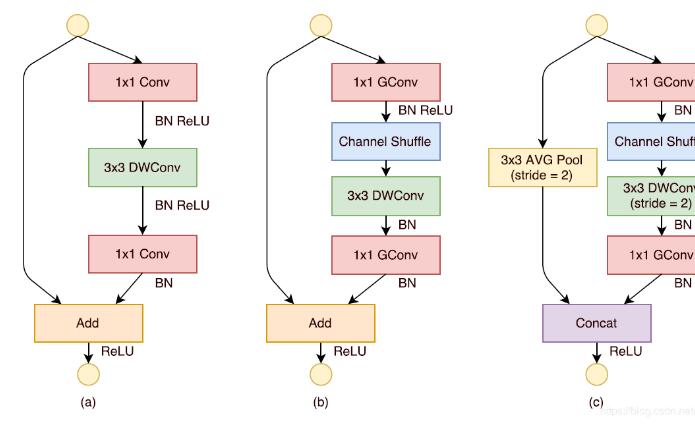
ShuffleNet的主要构成单元。下图中,a图为深度可分离卷积的基本架构,b图为1步长时用的单元,c图为2步长时用的单元。
ShuffleNet架构
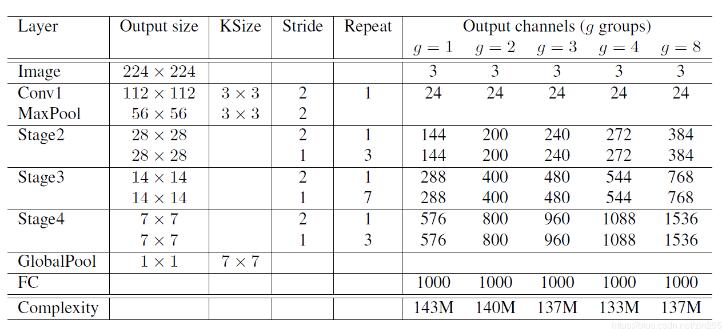
注意,对于第二阶段(Stage2),作者没有在第一个1×1卷积上应用组卷积,因为输入通道的数量相对较少。
环境
Python 3.6
Tensorlow 1.13.1
Keras 2.2.4
实现
支持channel first或channel last
# -*- coding: utf-8 -*-
"""
Created on Thu Apr 25 18:26:41 2019
@author: zjn
"""
import numpy as np
from keras.callbacks import LearningRateScheduler
from keras.models import Model
from keras.layers import Input, Conv2D, Dropout, Dense, GlobalAveragePooling2D, Concatenate, AveragePooling2D
from keras.layers import Activation, BatchNormalization, add, Reshape, ReLU, DepthwiseConv2D, MaxPooling2D, Lambda
from keras.utils.vis_utils import plot_model
from keras import backend as K
from keras.optimizers import SGD

def _group_conv(x, filters, kernel, stride, groups):
 """
 Group convolution

 # Arguments
  x: Tensor, input tensor of with `channels_last` or 'channels_first' data format
  filters: Integer, number of output channels
  kernel: An integer or tuple/list of 2 integers, specifying the
   width and height of the 2D convolution window.
  strides: An integer or tuple/list of 2 integers,
   specifying the strides of the convolution along the width and height.
   Can be a single integer to specify the same value for
   all spatial dimensions.
  groups: Integer, number of groups per channel

 # Returns
  Output tensor
 """

 channel_axis = 1 if K.image_data_format() == 'channels_first' else -1
 in_channels = K.int_shape(x)[channel_axis]

 # number of input channels per group
 nb_ig = in_channels // groups
 # number of output channels per group
 nb_og = filters // groups

 gc_list = []
 # Determine whether the number of filters is divisible by the number of groups
 assert filters % groups == 0

 for i in range(groups):
  if channel_axis == -1:
   x_group = Lambda(lambda z: z[:, :, :, i * nb_ig: (i + 1) * nb_ig])(x)
  else:
   x_group = Lambda(lambda z: z[:, i * nb_ig: (i + 1) * nb_ig, :, :])(x)
  gc_list.append(Conv2D(filters=nb_og, kernel_size=kernel, strides=stride,
        padding='same', use_bias=False)(x_group))

 return Concatenate(axis=channel_axis)(gc_list)
def _channel_shuffle(x, groups):
 """
 Channel shuffle layer

 # Arguments
  x: Tensor, input tensor of with `channels_last` or 'channels_first' data format
  groups: Integer, number of groups per channel

 # Returns
  Shuffled tensor
 """
 if K.image_data_format() == 'channels_last':
  height, width, in_channels = K.int_shape(x)[1:]
  channels_per_group = in_channels // groups
  pre_shape = [-1, height, width, groups, channels_per_group]
  dim = (0, 1, 2, 4, 3)
  later_shape = [-1, height, width, in_channels]
 else:
  in_channels, height, width = K.int_shape(x)[1:]
  channels_per_group = in_channels // groups
  pre_shape = [-1, groups, channels_per_group, height, width]
  dim = (0, 2, 1, 3, 4)
  later_shape = [-1, in_channels, height, width]

 x = Lambda(lambda z: K.reshape(z, pre_shape))(x)
 x = Lambda(lambda z: K.permute_dimensions(z, dim))(x)
 x = Lambda(lambda z: K.reshape(z, later_shape))(x)

 return x

def _shufflenet_unit(inputs, filters, kernel, stride, groups, stage, bottleneck_ratio=0.25):
 """
 ShuffleNet unit

 # Arguments
  inputs: Tensor, input tensor of with `channels_last` or 'channels_first' data format
  filters: Integer, number of output channels
  kernel: An integer or tuple/list of 2 integers, specifying the
   width and height of the 2D convolution window.
  strides: An integer or tuple/list of 2 integers,
   specifying the strides of the convolution along the width and height.
   Can be a single integer to specify the same value for
   all spatial dimensions.
  groups: Integer, number of groups per channel
  stage: Integer, stage number of ShuffleNet
  bottleneck_channels: Float, bottleneck ratio implies the ratio of bottleneck channels to output channels

 # Returns
  Output tensor

 # Note
  For Stage 2, we(authors of shufflenet) do not apply group convolution on the first pointwise layer
  because the number of input channels is relatively small.
 """
 channel_axis = 1 if K.image_data_format() == 'channels_first' else -1
 in_channels = K.int_shape(inputs)[channel_axis]
 bottleneck_channels = int(filters * bottleneck_ratio)

 if stage == 2:
  x = Conv2D(filters=bottleneck_channels, kernel_size=kernel, strides=1,
     padding='same', use_bias=False)(inputs)
 else:
  x = _group_conv(inputs, bottleneck_channels, (1, 1), 1, groups)
 x = BatchNormalization(axis=channel_axis)(x)
 x = ReLU()(x)

 x = _channel_shuffle(x, groups)
 x = DepthwiseConv2D(kernel_size=kernel, strides=stride, depth_multiplier=1,
      padding='same', use_bias=False)(x)
 x = BatchNormalization(axis=channel_axis)(x)

 if stride == 2:
  x = _group_conv(x, filters - in_channels, (1, 1), 1, groups)
  x = BatchNormalization(axis=channel_axis)(x)
  avg = AveragePooling2D(pool_size=(3, 3), strides=2, padding='same')(inputs)
  x = Concatenate(axis=channel_axis)([x, avg])
 else:
  x = _group_conv(x, filters, (1, 1), 1, groups)
  x = BatchNormalization(axis=channel_axis)(x)
  x = add([x, inputs])
 return x

def _stage(x, filters, kernel, groups, repeat, stage):
 """
 Stage of ShuffleNet

 # Arguments
  x: Tensor, input tensor of with `channels_last` or 'channels_first' data format
  filters: Integer, number of output channels
  kernel: An integer or tuple/list of 2 integers, specifying the
   width and height of the 2D convolution window.
  strides: An integer or tuple/list of 2 integers,
   specifying the strides of the convolution along the width and height.
   Can be a single integer to specify the same value for
   all spatial dimensions.
  groups: Integer, number of groups per channel
  repeat: Integer, total number of repetitions for a shuffle unit in every stage
  stage: Integer, stage number of ShuffleNet

 # Returns
  Output tensor
 """
 x = _shufflenet_unit(x, filters, kernel, 2, groups, stage)

 for i in range(1, repeat):
  x = _shufflenet_unit(x, filters, kernel, 1, groups, stage)
 return x

def ShuffleNet(input_shape, classes):
 """
 ShuffleNet architectures

 # Arguments
  input_shape: An integer or tuple/list of 3 integers, shape
   of input tensor
  k: Integer, number of classes to predict

 # Returns
  A keras model
 """
 inputs = Input(shape=input_shape)

 x = Conv2D(24, (3, 3), strides=2, padding='same', use_bias=True, activation='relu')(inputs)
 x = MaxPooling2D(pool_size=(3, 3), strides=2, padding='same')(x)

 x = _stage(x, filters=384, kernel=(3, 3), groups=8, repeat=4, stage=2)
 x = _stage(x, filters=768, kernel=(3, 3), groups=8, repeat=8, stage=3)
 x = _stage(x, filters=1536, kernel=(3, 3), groups=8, repeat=4, stage=4)

 x = GlobalAveragePooling2D()(x)

 x = Dense(classes)(x)
 predicts = Activation('softmax')(x)
 model = Model(inputs, predicts)
 return model

if __name__ == '__main__':
 model = ShuffleNet((224, 224, 3), 1000)
 #plot_model(model, to_file='ShuffleNet.png', show_shapes=True)
以上这篇keras 实现轻量级网络ShuffleNet教程就是小编分享给大家的全部内容了,希望能给大家一个参考,也希望大家多多支持脚本之家。
相关文章
 这篇文章主要介绍了Tensorflow中使用cpu和gpu有什么区别,具有很好的参考价值,希望对大家有所帮助。如有错误或未考虑完全的地方,望不吝赐教2022-05-05
 这篇文章主要给大家介绍了关于OpenCV图像的几何变换处理的相关资料,图像的几何变换是指将一幅图像映射到另一幅图像内,有缩放、翻转、仿射变换、透视、重映射等操作,需要的朋友可以参考下2024-03-03
 在python中如何实现将带小数的浮点型字符串转换为整数呢?今天小编就为大家介绍一下解决方案,希望对大家有所帮助。一起跟随小编过来看看吧2021-05-05
python pycharm最新版本激活码(永久有效)附python安装教程
PyCharm是一个多功能的集成开发环境,只需要在pycharm中创建python file就运行python,并且pycharm内置完备的功能,这篇文章给大家介绍python pycharm激活码最新版,需要的朋友跟随小编一起看看吧2020-01-01 在本篇文章里小编给网友们分享一篇关于关于Python错误重试方法总结内容,有需要的朋友们跟着学习参考下。2021-01-01
 今天小编就为大家分享一篇复化梯形求积分实例——用Python进行数值计算,具有很好的参考价值,希望对大家有所帮助。一起跟随小编过来看看吧2019-11-11
 今天小编就为大家分享一篇关于Python3爬虫全国地址信息,小编觉得内容挺不错的,现在分享给大家,具有很好的参考价值,需要的朋友一起跟随小编来看看吧2019-01-01
 今天小编就为大家分享一篇pytorch动态网络以及权重共享实例,具有很好的参考价值,希望对大家有所帮助。一起跟随小编过来看看吧2020-01-01
 在本篇文章里小编给大家分享的是关于Python中socket网络通信知识点内容,需要的朋友们可以跟着学习下。2020-05-05
 这篇文章主要介绍了Python使用configparser读取ini配置文件,文中通过示例代码介绍的非常详细,对大家的学习或者工作具有一定的参考学习价值,需要的朋友可以参考下2020-05-05
最新评论