

python实现高效的遗传算法
遗传算法属于一种优化算法。
如果你有一个待优化函数,可以考虑次算法。假设你有一个变量x,通过某个函数可以求出对应的y,那么你通过预设的x可求出y_pred,y_pred差距与你需要的y当然越接近越好,这就需要引入适应度(fitness)的概念。假设
fitness = 1/(1+ads(y_pred - y)),那么误差越小,适应度越大,即该个体越易于存活。
设计该算法的思路如下:
(1)初始化种群,即在我需要的区间如[-100,100]内random一堆初始个体[x1,x2,x3...],这些个体是10进制形式的,为了后面的交叉与变异我们不妨将其转化为二进制形式。那么现在的问题是二进制取多少位合适呢?即编码(code)的长度是多少呢?
这就涉及一些信号方面的知识,比如两位的二进制表示的最大值是3(11),可以将区间化为4分,那么每一份区间range长度range/4,我们只需要让range/n小于我们定义的精度即可。n是二进制需要表示的最大,可以反解出二进制位数 。
(2)我们需要编写编码与解码函数。即code:将x1,x2...化为二进制,decode:在交叉变异后重新得到十进制数,用于计算fitness。
(3)交叉后变异函数编写都很简单,random一个point,指定两个x在point位置进行切片交换即是交叉。变异也是random一个point,让其值0变为1,1变为0。
(4)得到交叉变异后的个体,需要计算fitness进行种群淘汰,保留fitness最高的一部分种群。
(5)将最优的个体继续上面的操作,直到你定义的iteration结束为止。
不说了,上代码:
import numpy as np
import pandas as pd
import random
from scipy.optimize import fsolve
import matplotlib.pyplot as plt
import heapq
from sklearn.model_selection import train_test_split
from tkinter import _flatten
from sklearn.utils import shuffle
from sklearn import preprocessing
from sklearn.decomposition import PCA
from matplotlib import rcParams


# 求染色体长度
def getEncodeLength(decisionvariables, delta):
 # 将每个变量的编码长度放入数组
 lengths = []
 for decisionvar in decisionvariables:
  uper = decisionvar[1]
  low = decisionvar[0]
  # res()返回一个数组
  res = fsolve(lambda x: ((uper - low) / delta - 2 ** x + 1), 30)
  # ceil()向上取整
  length = int(np.ceil(res[0]))
  lengths.append(length)
 # print("染色体长度:", lengths)
 return lengths


# 随机生成初始化种群
def getinitialPopulation(length, populationSize):
 chromsomes = np.zeros((populationSize, length), dtype=np.int)
 for popusize in range(populationSize):
  # np.random.randit()产生[0,2)之间的随机整数,第三个参数表示随机数的数量
  chromsomes[popusize, :] = np.random.randint(0, 2, length)
 return chromsomes


# 染色体解码得到表现形的解
def getDecode(population, encodelength, decisionvariables, delta):
 # 得到population中有几个元素
 populationsize = population.shape[0]
 length = len(encodelength)
 decodeVariables = np.zeros((populationsize, length), dtype=np.float)
 # 将染色体拆分添加到解码数组decodeVariables中
 for i, populationchild in enumerate(population):
  # 设置起始点
  start = 0
  for j, lengthchild in enumerate(encodelength):
   power = lengthchild - 1
   decimal = 0
   start_end = start + lengthchild
   for k in range(start, start_end):
    # 二进制转为十进制
    decimal += populationchild[k] * (2 ** power)
    power = power - 1
   # 从下一个染色体开始
   start = start_end
   lower = decisionvariables[j][0]
   uper = decisionvariables[j][1]
   # 转换为表现形
   decodevalue = lower + decimal * (uper - lower) / (2 ** lengthchild - 1)
   # 将解添加到数组中
   decodeVariables[i][j] = decodevalue

 return decodeVariables


# 选择新的种群
def selectNewPopulation(decodepopu, cum_probability):
 # 获取种群的规模和
 m, n = decodepopu.shape
 # 初始化新种群
 newPopulation = np.zeros((m, n))
 for i in range(m):
  # 产生一个0到1之间的随机数
  randomnum = np.random.random()
  # 轮盘赌选择
  for j in range(m):
   if (randomnum < cum_probability[j]):
    newPopulation[i] = decodepopu[j]
    break
 return newPopulation


# 新种群交叉
def crossNewPopulation(newpopu, prob):
 m, n = newpopu.shape
 # uint8将数值转换为无符号整型
 numbers = np.uint8(m * prob)
 # 如果选择的交叉数量为奇数,则数量加1
 if numbers % 2 != 0:
  numbers = numbers + 1
 # 初始化新的交叉种群
 updatepopulation = np.zeros((m, n), dtype=np.uint8)
 # 随机生成需要交叉的染色体的索引号
 index = random.sample(range(m), numbers)
 # 不需要交叉的染色体直接复制到新的种群中
 for i in range(m):
  if not index.__contains__(i):
   updatepopulation[i] = newpopu[i]
 # 交叉操作
 j = 0
 while j < numbers:
  # 随机生成一个交叉点,np.random.randint()返回的是一个列表
  crosspoint = np.random.randint(0, n, 1)
  crossPoint = crosspoint[0]
  # a = index[j]
  # b = index[j+1]
  updatepopulation[index[j]][0:crossPoint] = newpopu[index[j]][0:crossPoint]
  updatepopulation[index[j]][crossPoint:] = newpopu[index[j + 1]][crossPoint:]
  updatepopulation[index[j + 1]][0:crossPoint] = newpopu[j + 1][0:crossPoint]
  updatepopulation[index[j + 1]][crossPoint:] = newpopu[index[j]][crossPoint:]
  j = j + 2
 return updatepopulation


# 变异操作
def mutation(crosspopulation, mutaprob):
 # 初始化变异种群
 mutationpopu = np.copy(crosspopulation)
 m, n = crosspopulation.shape
 # 计算需要变异的基因数量
 mutationnums = np.uint8(m * n * mutaprob)
 # 随机生成变异基因的位置
 mutationindex = random.sample(range(m * n), mutationnums)
 # 变异操作
 for geneindex in mutationindex:
  # np.floor()向下取整返回的是float型
  row = np.uint8(np.floor(geneindex / n))
  colume = geneindex % n
  if mutationpopu[row][colume] == 0:
   mutationpopu[row][colume] = 1
  else:
   mutationpopu[row][colume] = 0
 return mutationpopu


# 找到重新生成的种群中适应度值最大的染色体生成新种群
def findMaxPopulation(population, maxevaluation, maxSize):
 #将数组转换为列表
 #maxevalue = maxevaluation.flatten()
 maxevaluelist = maxevaluation
 # 找到前100个适应度最大的染色体的索引
 maxIndex = map(maxevaluelist.index, heapq.nlargest(maxSize, maxevaluelist))
 index = list(maxIndex)
 colume = population.shape[1]
 # 根据索引生成新的种群
 maxPopulation = np.zeros((maxSize, colume))
 i = 0
 for ind in index:
  maxPopulation[i] = population[ind]
  i = i + 1
 return maxPopulation


# 得到每个个体的适应度值及累计概率
def getFitnessValue(decode,x_train,y_train):
 # 得到种群的规模和决策变量的个数
 popusize, decisionvar = decode.shape

 fitnessValue = []
 for j in range(len(decode)):
  W1 = decode[j][0:20].reshape(4,5)
  V1 = decode[j][20:25].T
  W2 = decode[j][25:45].reshape(5,4)
  V2 = decode[j][45:].T
  error_all = []
  for i in range(len(x_train)):
   #get values of hidde layer
   X2 = sigmoid(x_train[i].T.dot(W1)+V1)
   #get values of prediction y
   Y_hat = sigmoid(X2.T.dot(W2)+V2)
   #get error when input dimension is i
   error = sum(abs(Y_hat - y_train[i]))
   error_all.append(error)

  #get fitness when W and V is j
  fitnessValue.append(1/(1+sum(error_all)))

 # 得到每个个体被选择的概率
 probability = fitnessValue / np.sum(fitnessValue)
 # 得到每个染色体被选中的累积概率,用于轮盘赌算子使用
 cum_probability = np.cumsum(probability)
 return fitnessValue, cum_probability


def getFitnessValue_accuracy(decode,x_train,y_train):
 # 得到种群的规模和决策变量的个数
 popusize, decisionvar = decode.shape

 fitnessValue = []
 for j in range(len(decode)):
  W1 = decode[j][0:20].reshape(4,5)
  V1 = decode[j][20:25].T
  W2 = decode[j][25:45].reshape(5,4)
  V2 = decode[j][45:].T
  accuracy = []
  for i in range(len(x_train)):
   #get values of hidde layer
   X2 = sigmoid(x_train[i].T.dot(W1)+V1)
   #get values of prediction y
   Y_hat = sigmoid(X2.T.dot(W2)+V2)
   #get error when input dimension is i
   accuracy.append(sum(abs(np.round(Y_hat) - y_train[i])))
  fitnessValue.append(sum([m == 0 for m in accuracy])/len(accuracy))
 # 得到每个个体被选择的概率
 probability = fitnessValue / np.sum(fitnessValue)
 # 得到每个染色体被选中的累积概率,用于轮盘赌算子使用
 cum_probability = np.cumsum(probability)
 return fitnessValue, cum_probability


def getXY():
 # 要打开的文件名
 data_set = pd.read_csv('all-bp.csv', header=None)
 # 取出“特征”和“标签”,并做了转置,将列转置为行
 X_minMax1 = data_set.iloc[:, 0:12].values
 # 前12列是特征
 min_max_scaler = preprocessing.MinMaxScaler()
 X_minMax = min_max_scaler.fit_transform(X_minMax1) # 0-1 range
 transfer = PCA(n_components=0.9)
 data1 = transfer.fit_transform(X_minMax)
 #print('PCA processed shape:',data1.shape)
 X = data1
 Y = data_set.iloc[ : , 12:16].values # 后3列是标签

 # 分训练和测试集
 x_train, x_test, y_train, y_test = train_test_split(X, Y, test_size=0.3)
 return x_train, x_test, y_train, y_test


def sigmoid(z):
 return 1 / (1 + np.exp(-z))
上面的计算适应度函数需要自己更具实际情况调整。
optimalvalue = []
optimalvariables = []

# 两个决策变量的上下界,多维数组之间必须加逗号
decisionVariables = [[-100,100]]*49
# 精度
delta = 0.001
# 获取染色体长度
EncodeLength = getEncodeLength(decisionVariables, delta)
# 种群数量
initialPopuSize = 100
# 初始生成100个种群,20,5,20,4分别对用W1,V1,W2,V2
population = getinitialPopulation(sum(EncodeLength), initialPopuSize)
print("polpupation.shape:",population.shape)
# 最大进化代数
maxgeneration = 4000
# 交叉概率
prob = 0.8
# 变异概率
mutationprob = 0.5
# 新生成的种群数量
maxPopuSize = 30
x_train, x_test, y_train, y_test = getXY()


for generation in range(maxgeneration):
 # 对种群解码得到表现形
 print(generation)
 decode = getDecode(population, EncodeLength, decisionVariables, delta)
 #print('the shape of decode:',decode.shape

 # 得到适应度值和累计概率值
 evaluation, cum_proba = getFitnessValue_accuracy(decode,x_train,y_train)
 # 选择新的种群
 newpopulations = selectNewPopulation(population, cum_proba)
 # 新种群交叉
 crossPopulations = crossNewPopulation(newpopulations, prob)
 # 变异操作
 mutationpopulation = mutation(crossPopulations, mutationprob)

 # 将父母和子女合并为新的种群
 totalpopulation = np.vstack((population, mutationpopulation))
 # 最终解码
 final_decode = getDecode(totalpopulation, EncodeLength, decisionVariables, delta)
 # 适应度评估
 final_evaluation, final_cumprob = getFitnessValue_accuracy(final_decode,x_train,y_train)
 #选出适应度最大的100个重新生成种群
 population = findMaxPopulation(totalpopulation, final_evaluation, maxPopuSize)

 # 找到本轮中适应度最大的值
 optimalvalue.append(np.max(final_evaluation))
 index = np.where(final_evaluation == max(final_evaluation))
 optimalvariables.append(list(final_decode[index[0][0]]))
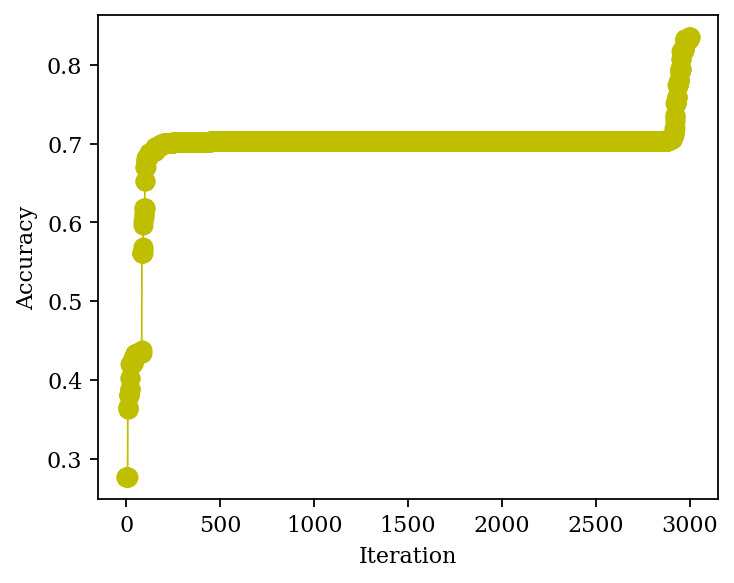
fig = plt.figure(dpi = 160,figsize=(5,4))
config = {
"font.family":"serif", #serif
"font.size": 10,
"mathtext.fontset":'stix',
}
rcParams.update(config)
plt.plot(np.arange(len(optimalvalue)), optimalvalue, color="y", lw=0.8, ls='-', marker='o', ms=8)
# 图例设置
plt.xlabel('Iteration')
plt.ylabel('Accuracy')
plt.show()
以上就是python实现高效的遗传算法的详细内容,更多关于python遗传算法的资料请关注脚本之家其它相关文章!
相关文章
 下面小编就为大家带来一篇sublime text 3配置使用python操作方法。小编觉得挺不错的,现在就分享给大家,也给大家做个参考。一起跟随小编过来看看吧2017-06-06
 在当今的文档处理中,Markdown因其简洁的语法和易读性而广受欢迎,而Microsoft Word(DOCX格式)则因其广泛的兼容性和专业的排版效果成为商业文档的标准,本文将介绍如何使用Python构建一个带有图形界面的Markdown转Word文档转换器,需要的朋友可以参考下2025-02-02
 下面小编就为大家分享一篇python 处理dataframe中的时间字段方法,具有很好的参考价值,希望对大家有所帮助。一起跟随小编过来看看吧2018-04-04
 这篇文章主要介绍了Python坐标线性插值应用实现,文中通过示例代码介绍的非常详细,对大家的学习或者工作具有一定的参考学习价值,需要的朋友们下面随着小编来一起学习学习吧2019-11-11
 这篇文章主要介绍了python实现括号匹配及匹配格式的相关知识,非常不错,具有一定的参考借鉴价值,需要的朋友可以参考下2018-08-08
 小编个人认为python比c++更容易读并且已经有很多包装很好的科学运算库(numpy,scikit等),今天通过本文给大家分享Python api构建tensorrt加速模型的步骤,感兴趣的朋友一起看看吧2021-09-09
 这篇文章主要给大家介绍了关于python中tcp协议的相关资料,文中通过示例代码介绍的非常详细,对大家的学习或者工作具有一定的参考学习价值,需要的朋友们下面随着小编来一起学习学习吧2018-12-12
 本篇文章主要介绍了详解python并发获取snmp信息及性能测试,小编觉得挺不错的,现在分享给大家,也给大家做个参考。一起跟随小编过来看看吧2017-03-03
 这篇文章主要介绍了Python实现字符串逆序输出功能,结合具体实例形式分析了Python针对字符串的遍历、翻转、排序等相关操作技巧,需要的朋友可以参考下2017-06-06
 这篇文章主要为大家详细介绍了如何通过Python实现Excel数据的读取,文中的示例代码讲解详细,对我们学习有一定帮助,需要的可以参考一下2022-05-05
最新评论