

pytorch实现线性回归以及多元回归
更新时间:2021年04月09日 17:36:21 作者:Lee_lv
这篇文章主要为大家详细介绍了pytorch实现线性回归以及多元回归,文中示例代码介绍的非常详细,具有一定的参考价值,感兴趣的小伙伴们可以参考一下
本文实例为大家分享了pytorch实现线性回归以及多元回归的具体代码,供大家参考,具体内容如下
最近在学习pytorch,现在把学习的代码放在这里,下面是github链接
直接附上github代码
# 实现一个线性回归
# 所有的层结构和损失函数都来自于 torch.nn
# torch.optim 是一个实现各种优化算法的包,调用的时候必须是需要优化的参数传入,这些参数都必须是Variable

x_train = np.array([[3.3],[4.4],[5.5],[6.71],[6.93],[4.168],[9.779],[6.182],[7.59],[2.167],[7.042],[10.791],[5.313],[7.997],[3.1]],dtype=np.float32)
y_train = np.array([[1.7],[2.76],[2.09],[3.19],[1.694],[1.573],[3.366],[2.596],[2.53],[1.221],[2.827],[3.465],[1.65],[2.904],[1.3]],dtype=np.float32)

# 首先我们需要将array转化成tensor,因为pytorch处理的单元是Tensor

x_train = torch.from_numpy(x_train)
y_train = torch.from_numpy(y_train)


# def a simple network

class LinearRegression(nn.Module):
    def __init__(self):
        super(LinearRegression,self).__init__()
        self.linear = nn.Linear(1, 1)  # input and output is 2_dimension
    def forward(self, x):
        out = self.linear(x)
        return out


if torch.cuda.is_available():
    model = LinearRegression().cuda()
    #model = model.cuda()
else:
    model = LinearRegression()
    #model = model.cuda()

# 定义loss function 和 optimize func
criterion = nn.MSELoss()   # 均方误差作为优化函数
optimizer = torch.optim.SGD(model.parameters(),lr=1e-3)
num_epochs = 30000
for epoch in range(num_epochs):
    if torch.cuda.is_available():
        inputs = Variable(x_train).cuda()
        outputs = Variable(y_train).cuda()
    else:
        inputs = Variable(x_train)
        outputs = Variable(y_train)

    # forward
    out = model(inputs)
    loss = criterion(out,outputs)

    # backword
    optimizer.zero_grad()  # 每次做反向传播之前都要进行归零梯度。不然梯度会累加在一起,造成不收敛的结果
    loss.backward()
    optimizer.step()

    if (epoch +1)%20==0:
        print('Epoch[{}/{}], loss: {:.6f}'.format(epoch+1,num_epochs,loss.data))


model.eval()  # 将模型变成测试模式
predict = model(Variable(x_train).cuda())
predict = predict.data.cpu().numpy()
plt.plot(x_train.numpy(),y_train.numpy(),'ro',label = 'original data')
plt.plot(x_train.numpy(),predict,label = 'Fitting line')
plt.show()
结果如图所示:
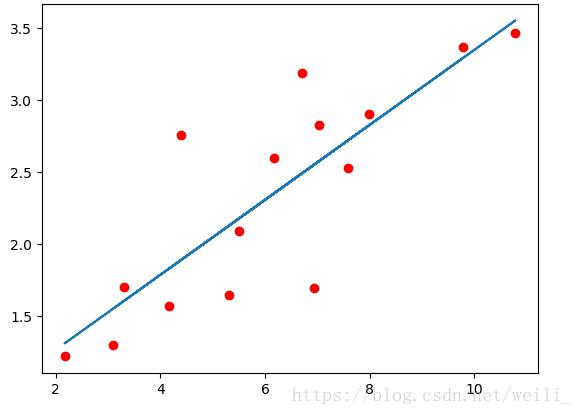
多元回归:
# _*_encoding=utf-8_*_
# pytorch 里面最基本的操作对象是Tensor,pytorch 的tensor可以和numpy的ndarray相互转化。
# 实现一个线性回归
# 所有的层结构和损失函数都来自于 torch.nn
# torch.optim 是一个实现各种优化算法的包,调用的时候必须是需要优化的参数传入,这些参数都必须是Variable


# 实现 y = b + w1 *x + w2 *x**2 +w3*x**3
import os
os.environ['CUDA_DEVICE_ORDER']="PCI_BUS_ID"
os.environ['CUDA_VISIBLE_DEVICES']='0'
import torch
import numpy as np
from torch.autograd import Variable
import matplotlib.pyplot as plt
from torch import nn


# pre_processing
def make_feature(x):
    x = x.unsqueeze(1)   # unsquenze 是为了添加维度1的,0表示第一维度,1表示第二维度,将tensor大小由3变为(3,1)
    return torch.cat([x ** i for i in range(1, 4)], 1)

# 定义好真实的数据


def f(x):
    W_output = torch.Tensor([0.5, 3, 2.4]).unsqueeze(1)
    b_output = torch.Tensor([0.9])
    return x.mm(W_output)+b_output[0]  # 外积,矩阵乘法


# 批量处理数据
def get_batch(batch_size =32):

    random = torch.randn(batch_size)
    x = make_feature(random)
    y = f(x)
    if torch.cuda.is_available():

        return Variable(x).cuda(),Variable(y).cuda()
    else:
        return Variable(x),Variable(y)


# def model
class poly_model(nn.Module):
    def __init__(self):
        super(poly_model,self).__init__()
        self.poly = nn.Linear(3,1)
    def forward(self,input):
        output = self.poly(input)
        return output

if torch.cuda.is_available():
    print("sdf")
    model = poly_model().cuda()
else:
    model = poly_model()


# 定义损失函数和优化器
criterion = nn.MSELoss()
optimizer = torch.optim.SGD(model.parameters(), lr=1e-3)

epoch = 0
while True:
    batch_x, batch_y = get_batch()
    #print(batch_x)
    output = model(batch_x)
    loss = criterion(output,batch_y)
    print_loss = loss.data
    optimizer.zero_grad()
    loss.backward()
    optimizer.step()
    epoch = epoch +1
    if print_loss < 1e-3:
        print(print_loss)
        break

model.eval()
print("Epoch = {}".format(epoch))

batch_x, batch_y = get_batch()
predict = model(batch_x)
a = predict - batch_y
y = torch.sum(a)
print('y = ',y)
predict = predict.data.cpu().numpy()
plt.plot(batch_x.cpu().numpy(),batch_y.cpu().numpy(),'ro',label = 'Original data')
plt.plot(batch_x.cpu().numpy(),predict,'b', ls='--',label = 'Fitting line')
plt.show()
以上就是本文的全部内容,希望对大家的学习有所帮助,也希望大家多多支持脚本之家。
相关文章
 这篇文章主要介绍了Python安装后测试连接MySQL数据库方式,具有很好的参考价值,希望对大家有所帮助,如有错误或未考虑完全的地方,望不吝赐教2024-07-07
 这篇文章主要为大家介绍了python密码学对称和非对称密码教程,有需要的朋友可以借鉴参考下,希望能够有所帮助,祝大家多多进步,早日升职加薪2022-05-05
 FastAPI中最核心的之一就是路径参数,所以这篇文章小编主要来和大家介绍一下FastAPI查询参数的作用以及基本使用,有需要的小伙伴可以参考下2024-03-03
 这篇文章主要给大家介绍了关于利用Python进行数据可视化常见的9种方法!文中介绍的方法真的超实用!对大家学习或者使用python具有一定的参考学习价值,需要的朋友们下面随着小编来一起学习学习吧2018-07-07
 今天小编就为大家分享一篇Python中交换两个元素的实现方法,具有很好的参考价值,希望对大家有所帮助。一起跟随小编过来看看吧2018-06-06
 这篇文章主要介绍了TensorFlow实现批量归一化操作的示例,文中通过示例代码介绍的非常详细,对大家的学习或者工作具有一定的参考学习价值,需要的朋友们下面随着小编来一起学习学习吧2020-04-04
使用python查找替换PowerPoint演示文稿中的文本
演示文稿已成为商务会议、学术报告和教育培训中不可或缺的一部分,而PowerPoint演示文稿作为行业标准工具,更是承载着无数创意与信息的载体,本文将介绍如何使用Python来精确查找并替换PowerPoint演示文稿中的文本,需要的朋友可以参考下2024-07-07 这篇文章主要介绍了python 装饰器的相关资料,帮助大家更好的理解和学习python装饰器的相关知识,感兴趣的朋友可以了解下2020-09-09
 这篇文章主要为大家详细介绍了Pyqt5实现英文学习词典的相关方法,具有一定的参考价值,感兴趣的小伙伴们可以参考一下2019-06-06
 今天小编就为大家分享一篇Python 实现文件打包、上传与校验的方法,具有很好的参考价值,希望对大家有所帮助。一起跟随小编过来看看吧2019-02-02
最新评论