

C/C++中多重继承详解及其作用介绍
更新时间:2021年09月06日 16:13:50 作者:我是小白呀
这篇文章主要介绍了C/C++中多重继承详解及其作用介绍,本文给大家介绍的非常详细,对大家的学习或工作具有一定的参考借鉴价值,需要的朋友可以参考下
概述
多重继承 (multiple inheritance): 一个派生类有两个或多个基类, 派生类从两个或多个基类中继承所需的属性. C++ 为了适应这种情况, 允许一个派生类同时继承多个基类. 这种行为称为多重继承.
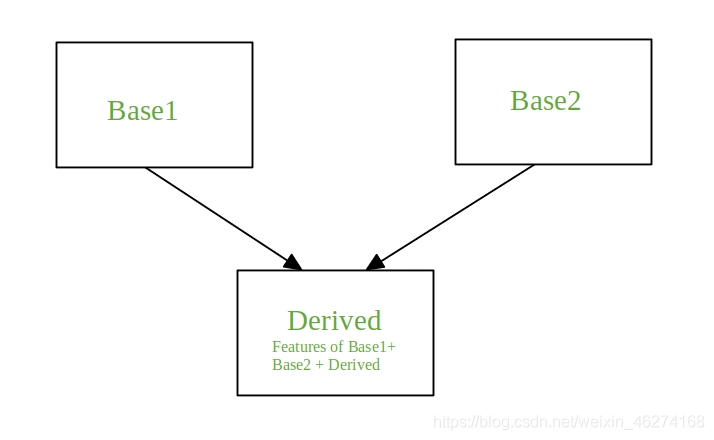
优缺点
优点
- 自然地做到了对单继承的扩展
- 可以继承多个类的功能
缺点
- 结构复杂化
- 优先顺序模糊
- 功能冲突
声明多重继承的方法
格式
多重继承的格式:
派生类构造函数名(总形式参数表列):
    基类1构造函数(实际参数表列),
    基类2构造函数(实际参数表列),
    基类3构造函数(实际参数表列)
{
    派生类中新增数成员据成员初始化语句
}
例子
Teacher 类:
#ifndef PROJECT5_TEACHER_H
#define PROJECT5_TEACHER_H

#include <string>
using namespace std;

class Teacher {
protected:
    string name;
    int age;
    string title;
public:
    Teacher(string n, int a, string t);
    void display_teacher();
};

#endif //PROJECT5_TEACHER_H
Teacher.cpp:
#include <iostream>
#include "Teacher.h"
using namespace std;

Teacher::Teacher(string n, int a, string t) : name(n), age(a), title(t) {}

void Teacher::display_teacher() {
    cout << "Teacher name: " << name << endl;
    cout << "age: " << age << endl;
    cout << "title: " << title << endl;
}
Student 类:
#ifndef PROJECT5_STUDENT_H
#define PROJECT5_STUDENT_H

#include <string>
using namespace std;

class Student {
protected:
    string name;
    char gender;
    double score;
public:
    Student(string n, char g, double s);
    void display_student();
};

#endif //PROJECT5_STUDENT_H
Student.cpp:
#include <iostream>
#include "Student.h"
using namespace std;

Student::Student(string n, char g, double s) : name(n), gender(g), score(s) {}

void Student::display_student() {
    cout << "Student name: " << name << endl;
    cout << "gender: " << gender << endl;
    cout << "score: " << score << endl;
}
Graduate 类:
#ifndef PROJECT5_GRADUATE_H
#define PROJECT5_GRADUATE_H

#include "Teacher.h"
#include "Student.h"
#include <string>
using namespace std;

class Graduate : public Teacher, public Student{
private:
    double wage;
public:
    Graduate(string t_n, int t_a, string t_t, string s_n, char s_g, double s_s);
    void display_graduate();
};

#endif //PROJECT5_GRADUATE_H
Graduate.cpp:
#include "Graduate.h"

Graduate::Graduate(string t_n, int t_a, string t_t, string s_n, char s_g, double s_s) :
    Teacher(t_n, t_a, t_t),
    Student(s_n, s_g, s_s) {}

void Graduate::display_graduate() {
    display_teacher();
    display_student();
}
main:
#include <iostream>
#include "Graduate.h"
using namespace std;

int main() {
    Graduate graduate1("王叔叔", 18, "隔壁老王", "我是小白呀", 'f', 99);
    graduate1.display_graduate();

    return 0;
}
输出结果:
Teacher name: 王叔叔
age: 18
title: 隔壁老王
Student name: 我是小白呀
gender: f
score: 99
二义性
二义性 (Ambiguity) 指在多重继承中, 两个基类中的数据成员名相同.
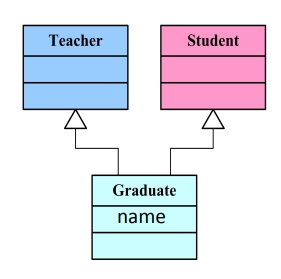
二义性在派生类中的解决方法:
- 在标识符前用类名做前缀: Teacher::name 和 Student::name
- 基类和派生类需要有一个完整的设计, 不能随意而为
两个基类有同名成员
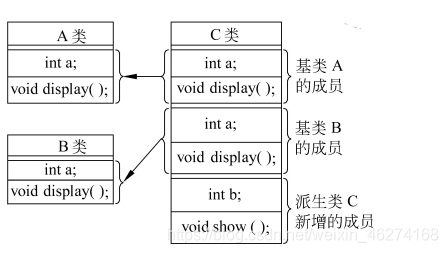
A 类:
#ifndef PROJECT5_A_H
#define PROJECT5_A_H

#include <iostream>
using namespace std;

class A {
public:
    int num;
    void display() {cout << "A's num:" << num << endl;};
};

#endif //PROJECT5_A_H
B 类:
#ifndef PROJECT5_B_H
#define PROJECT5_B_H

#include <iostream>
using namespace std;

class B {
public:
    int num;
    void display() {cout << "B's num:" << num << endl;};
};

#endif //PROJECT5_B_H
C 类:
#ifndef PROJECT5_C_H
#define PROJECT5_C_H

#include <iostream>
#include "A.h"
#include "B.h"
using namespace std;

class C: public A, public B{
public:
    int c;
    void display() {cout << c << endl;};
};

#endif //PROJECT5_C_H
main:
#include <iostream>
#include "C.h"
using namespace std;

int main() {
    C c1;
    c1.A::num = 1;  // 用基类名限定
    c1.B::num = 2;  // 用基类名限定
    c1.A::display();
    c1.B::display();

    return 0;
}
输出结果:
A's num:1
B's num:2
错误的写法
#include <iostream>
#include "C.h"
using namespace std;

int main() {
    C c1;
    c1.num = 1;
    c1.display();

    return 0;
}
基类和派生类有同名成员
A 类:
class A {
public:
    int num;
    void display() {cout << "A's num:" << num << endl;};
};
B 类:
class B {
public:
    int num;
    void display() {cout << "B's num:" << num << endl;};
};
C 类:
class C: public A, public B{
public:
    int num;
    void display() {cout << "C's num:" << num << endl;};
};
main:
int main() {
    C c1;
    c1.num = 3;
    c1.A::num = 1;
    c1.B::num = 2;
    c1.display();
    c1.A::display();
    c1.B::display();

    return 0;
}
输出结果:
C's num:3
A's num:1
B's num:2
同名覆盖:
- 基类的同名成员在派生类中被屏蔽, 成为 "不可见"的
- 对成员函数, 限于函数名和参数个数相同, 类型相匹配. 若只有函数名相同而参数不同, 属于函数重载
两个基类从同一个基类派生
N 类:
class N {
public:
    int a;
    void display(){
        cout << "A::a=" << a <<endl;
    }
};
A 类:
class A : public N {
public:
    int a1;
};
B 类:
class B : public N {
public:
    int a2;
};
C 类:
class C: public A, public B{
public:
    int a3;
    void display() {cout << "a3=" << a3 << endl;};
};
main:
int main() {
    C c1;
    // 合法访问
    c1.A::a = 3;
    c1.A::display();

    return 0;
}
输出结果:
A::a=3
到此这篇关于C/C++中多重继承详解及其作用介绍的文章就介绍到这了,更多相关C++多重继承内容请搜索脚本之家以前的文章或继续浏览下面的相关文章希望大家以后多多支持脚本之家!
相关文章

详谈全排列next_permutation() 函数的用法(推荐)
下面小编就为大家带来一篇详谈全排列next_permutation() 函数的用法(推荐)。小编觉得挺不错的,现在就分享给大家,也给大家做个参考。一起跟随小编过来看看吧2017-03-03 这篇文章主要介绍了c++ 移动赋值/移动构造函数的实现,文中通过示例代码介绍的非常详细,对大家的学习或者工作具有一定的参考学习价值,需要的朋友们下面随着小编来一起学习学习吧2026-03-03
 这篇文章主要为大家详细介绍了C语言实现简易扑克牌游戏,文中示例代码介绍的非常详细,具有一定的参考价值,感兴趣的小伙伴们可以参考一下2019-10-10
 插入排序的基本思想是每次将一个待排序的记录,按其关键字大小插入到前面已经排好序的子文件中的适当位置,直到全部记录插入完成为止。下面我们来详细探讨下C++实现插入排序2017-05-05
 栈和队列是一种数据结构,只规定了性质,并没有规定实现方式。本文将以顺序结构实现栈,链表方式实现队列,感兴趣的小伙伴快跟随小编一起学习一下吧2022-08-08
 本文给大家分享的是一个个人使用C++编写的时间函数类,主要是实现了类的定义和调用,相比较来说还算比较复杂的时间类了,推荐给小伙伴们,有需要的朋友可以参考下。2015-03-03
在输入输出字符串时scanf(),printf()和gets(),puts()的区别浅谈
在输入输出字符串时scanf(),printf()和gets(),puts()的区别浅谈,需要的朋友可以参考一下2013-02-02 这篇文章主要介绍了C语言基本排序算法之插入排序与直接选择排序实现方法,结合具体实例形式分析了插入排序与直接选择排序的定义、使用方法及相关注意事项,需要的朋友可以参考下2017-09-09
 Boost是为C++语言标准库提供扩展的一些C++程序库的总称。Boost库是一个可移植、提供源代码的C++库,作为标准库的后备,是C++标准化进程的开发引擎之一,是为C++语言标准库提供扩展的一些C++程序库的总称2022-11-11
 本文主要介绍了详解C++中代理模式高级应用,文中通过示例代码介绍的非常详细,对大家的学习或者工作具有一定的参考学习价值,需要的朋友们下面随着小编来一起学习学习吧2025-10-10
最新评论