

为何Linq的Distinct实在是不给力
更新时间:2013年05月13日 17:56:07 作者:
本篇文章对Linq的Distinct进行了详细的分析介绍,需要的朋友参考下
假设我们有一个类:Product
public class Product
{
public string Id { get; set; }
public string Name { get; set; }
}
Main函数如下:
static void Main()
{
List<Product> products = new List<Product>()
{
new Product(){ Id="1", Name="n1"},
new Product(){ Id="1", Name="n2"},
new Product(){ Id="2", Name="n1"},
new Product(){ Id="2", Name="n2"},
};
var distinctProduct = products.Distinct();
Console.ReadLine();
}
可以看到distinctProduct 的结果是:
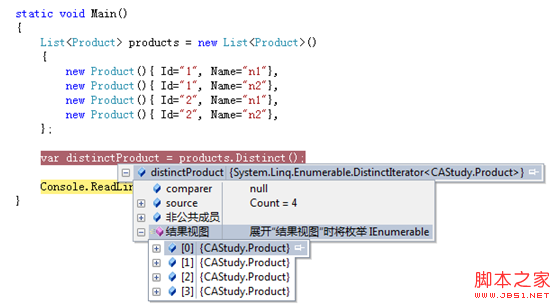
因为Distinct 默认比较的是Product对象的引用,所以返回4条数据。
那么如果我们希望返回Id唯一的product,那么该如何做呢?
Distinct方法还有另一个重载:
//通过使用指定的 System.Collections.Generic.IEqualityComparer<T> 对值进行比较
//返回序列中的非重复元素。
public static IEnumerable<TSource> Distinct<TSource>(this IEnumerable<TSource> source,
IEqualityComparer<TSource> comparer);
该重载接收一个IEqualityComparer的参数。
假设要按Id来筛选,那么应该新建类ProductIdComparer 内容如下:
public class ProductIdComparer : IEqualityComparer<Product>
{
public bool Equals(Product x, Product y)
{
if (x == null)
return y == null;
return x.Id == y.Id;
}
public int GetHashCode(Product obj)
{
if (obj == null)
return 0;
return obj.Id.GetHashCode();
}
}
使用的时候,只需要
var distinctProduct = products.Distinct(new ProductIdComparer());
结果如下:
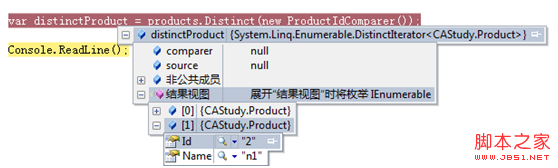
现在假设我们要 按照 Name来筛选重复呢?
很明显,需要再添加一个类ProductNameComparer.
那能不能使用泛型类呢??
新建类PropertyComparer<T> 继承IEqualityComparer<T> 内容如下:
public class PropertyComparer<T> : IEqualityComparer<T>
{
private PropertyInfo _PropertyInfo;
/// <summary>
/// 通过propertyName 获取PropertyInfo对象
/// </summary>
/// <param name="propertyName"></param>
public PropertyComparer(string propertyName)
{
_PropertyInfo = typeof(T).GetProperty(propertyName,
BindingFlags.GetProperty | BindingFlags.Instance | BindingFlags.Public);
if (_PropertyInfo == null)
{
throw new ArgumentException(string.Format("{0} is not a property of type {1}.",
propertyName, typeof(T)));
}
}
#region IEqualityComparer<T> Members
public bool Equals(T x, T y)
{
object xValue = _PropertyInfo.GetValue(x, null);
object yValue = _PropertyInfo.GetValue(y, null);
if (xValue == null)
return yValue == null;
return xValue.Equals(yValue);
}
public int GetHashCode(T obj)
{
object propertyValue = _PropertyInfo.GetValue(obj, null);
if (propertyValue == null)
return 0;
else
return propertyValue.GetHashCode();
}
#endregion
}
主要是重写的Equals 和GetHashCode 使用了属性的值比较。
使用的时候,只需要:
//var distinctProduct = products.Distinct(new PropertyComparer<Product>("Id"));
var distinctProduct = products.Distinct(new PropertyComparer<Product>("Name"));
结果如下:
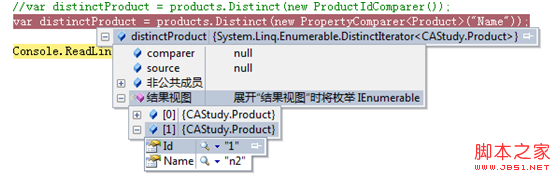
为什么微软不提供PropertyEquality<T> 这个类呢?
按照上面的逻辑,这个类应该没有很复杂啊,细心的同学可以发现PropertyEquality 大量的使用了反射。每次获取属性的值的时候,都在调用
_PropertyInfo.GetValue(x, null);
可想而知,如果要筛选的记录非常多的话,那么性能无疑会受到影响。
为了提升性能,可以使用表达式树将反射调用改为委托调用,
具体代码如下:
public class FastPropertyComparer<T> : IEqualityComparer<T>
{
private Func<T, Object> getPropertyValueFunc = null;
/// <summary>
/// 通过propertyName 获取PropertyInfo对象
/// </summary>
/// <param name="propertyName"></param>
public FastPropertyComparer(string propertyName)
{
PropertyInfo _PropertyInfo = typeof(T).GetProperty(propertyName,
BindingFlags.GetProperty | BindingFlags.Instance | BindingFlags.Public);
if (_PropertyInfo == null)
{
throw new ArgumentException(string.Format("{0} is not a property of type {1}.",
propertyName, typeof(T)));
}
ParameterExpression expPara = Expression.Parameter(typeof(T), "obj");
MemberExpression me = Expression.Property(expPara, _PropertyInfo);
getPropertyValueFunc = Expression.Lambda<Func<T, object>>(me, expPara).Compile();
}
#region IEqualityComparer<T> Members
public bool Equals(T x, T y)
{
object xValue = getPropertyValueFunc(x);
object yValue = getPropertyValueFunc(y);
if (xValue == null)
return yValue == null;
return xValue.Equals(yValue);
}
public int GetHashCode(T obj)
{
object propertyValue = getPropertyValueFunc(obj);
if (propertyValue == null)
return 0;
else
return propertyValue.GetHashCode();
}
#endregion
}
可以看到现在获取值只需要getPropertyValueFunc(obj) 就可以了。
使用的时候:
var distinctProduct = products.Distinct(new FastPropertyComparer<Product>("Id")).ToList();
public class Product
{
public string Id { get; set; }
public string Name { get; set; }
}
Main函数如下:
static void Main()
{
List<Product> products = new List<Product>()
{
new Product(){ Id="1", Name="n1"},
new Product(){ Id="1", Name="n2"},
new Product(){ Id="2", Name="n1"},
new Product(){ Id="2", Name="n2"},
};
var distinctProduct = products.Distinct();
Console.ReadLine();
}
可以看到distinctProduct 的结果是:
因为Distinct 默认比较的是Product对象的引用,所以返回4条数据。
那么如果我们希望返回Id唯一的product,那么该如何做呢?
Distinct方法还有另一个重载:
//通过使用指定的 System.Collections.Generic.IEqualityComparer<T> 对值进行比较
//返回序列中的非重复元素。
public static IEnumerable<TSource> Distinct<TSource>(this IEnumerable<TSource> source,
IEqualityComparer<TSource> comparer);
该重载接收一个IEqualityComparer的参数。
假设要按Id来筛选,那么应该新建类ProductIdComparer 内容如下:
public class ProductIdComparer : IEqualityComparer<Product>
{
public bool Equals(Product x, Product y)
{
if (x == null)
return y == null;
return x.Id == y.Id;
}
public int GetHashCode(Product obj)
{
if (obj == null)
return 0;
return obj.Id.GetHashCode();
}
}
使用的时候,只需要
var distinctProduct = products.Distinct(new ProductIdComparer());
结果如下:
现在假设我们要 按照 Name来筛选重复呢?
很明显,需要再添加一个类ProductNameComparer.
那能不能使用泛型类呢??
新建类PropertyComparer<T> 继承IEqualityComparer<T> 内容如下:
public class PropertyComparer<T> : IEqualityComparer<T>
{
private PropertyInfo _PropertyInfo;
/// <summary>
/// 通过propertyName 获取PropertyInfo对象
/// </summary>
/// <param name="propertyName"></param>
public PropertyComparer(string propertyName)
{
_PropertyInfo = typeof(T).GetProperty(propertyName,
BindingFlags.GetProperty | BindingFlags.Instance | BindingFlags.Public);
if (_PropertyInfo == null)
{
throw new ArgumentException(string.Format("{0} is not a property of type {1}.",
propertyName, typeof(T)));
}
}
#region IEqualityComparer<T> Members
public bool Equals(T x, T y)
{
object xValue = _PropertyInfo.GetValue(x, null);
object yValue = _PropertyInfo.GetValue(y, null);
if (xValue == null)
return yValue == null;
return xValue.Equals(yValue);
}
public int GetHashCode(T obj)
{
object propertyValue = _PropertyInfo.GetValue(obj, null);
if (propertyValue == null)
return 0;
else
return propertyValue.GetHashCode();
}
#endregion
}
主要是重写的Equals 和GetHashCode 使用了属性的值比较。
使用的时候,只需要:
//var distinctProduct = products.Distinct(new PropertyComparer<Product>("Id"));
var distinctProduct = products.Distinct(new PropertyComparer<Product>("Name"));
结果如下:
为什么微软不提供PropertyEquality<T> 这个类呢?
按照上面的逻辑,这个类应该没有很复杂啊,细心的同学可以发现PropertyEquality 大量的使用了反射。每次获取属性的值的时候,都在调用
_PropertyInfo.GetValue(x, null);
可想而知,如果要筛选的记录非常多的话,那么性能无疑会受到影响。
为了提升性能,可以使用表达式树将反射调用改为委托调用,
具体代码如下:
public class FastPropertyComparer<T> : IEqualityComparer<T>
{
private Func<T, Object> getPropertyValueFunc = null;
/// <summary>
/// 通过propertyName 获取PropertyInfo对象
/// </summary>
/// <param name="propertyName"></param>
public FastPropertyComparer(string propertyName)
{
PropertyInfo _PropertyInfo = typeof(T).GetProperty(propertyName,
BindingFlags.GetProperty | BindingFlags.Instance | BindingFlags.Public);
if (_PropertyInfo == null)
{
throw new ArgumentException(string.Format("{0} is not a property of type {1}.",
propertyName, typeof(T)));
}
ParameterExpression expPara = Expression.Parameter(typeof(T), "obj");
MemberExpression me = Expression.Property(expPara, _PropertyInfo);
getPropertyValueFunc = Expression.Lambda<Func<T, object>>(me, expPara).Compile();
}
#region IEqualityComparer<T> Members
public bool Equals(T x, T y)
{
object xValue = getPropertyValueFunc(x);
object yValue = getPropertyValueFunc(y);
if (xValue == null)
return yValue == null;
return xValue.Equals(yValue);
}
public int GetHashCode(T obj)
{
object propertyValue = getPropertyValueFunc(obj);
if (propertyValue == null)
return 0;
else
return propertyValue.GetHashCode();
}
#endregion
}
可以看到现在获取值只需要getPropertyValueFunc(obj) 就可以了。
使用的时候:
var distinctProduct = products.Distinct(new FastPropertyComparer<Product>("Id")).ToList();
您可能感兴趣的文章:
- 使用distinct在mysql中查询多条不重复记录值的解决办法
- distinct 多列问题结合group by的解决方法
- sqlserver中distinct的用法(不重复的记录)
- 使用GROUP BY的时候如何统计记录条数 COUNT(*) DISTINCT
- oracle sql 去重复记录不用distinct如何实现
- 解析mysql中:单表distinct、多表group by查询去除重复记录
- MongoDB教程之聚合(count、distinct和group)
- mongodb中使用distinct去重的简单方法
- SQL中distinct的用法(四种示例分析)
- oracle中distinct的用法详解
- SQL select distinct的使用方法
- 针对distinct疑问引发的一系列思考
相关文章
 这篇文章主要介绍了C#实现过滤sql特殊字符的方法,以实例形式分析总结了C#针对SQL危险字符的几种常用的过滤技巧,非常具有实用价值,需要的朋友可以参考下2015-11-11
 这篇文章主要介绍了C#构建树形结构数据(全部构建,查找构建),小编觉得挺不错的,现在分享给大家,也给大家做个参考。一起跟随小编过来看看吧2017-10-10
 这篇文章主要介绍了C#中dotnetcharting的用法,以实例形式详细分析了基于dotnetcharting的图表绘制的各种常用方法,是非常实用的技巧,需要的朋友可以参考下2014-10-10
 这篇文章主要介绍了C#调用VB进行简繁转换的方法,通过调用VB的动态链接库实现繁简转换的技巧,非常具有实用价值,需要的朋友可以参考下2015-02-02
 这篇文章主要介绍了C# LINQ查询表达式及对应LAMBDA表达式的用法,帮助大家更好的理解和学习使用c#,感兴趣的朋友可以了解下2021-04-04
 这篇文章主要为大家详细介绍了C#中线程传参,返回值和多线程冲突问题的解决方法,文中的示例代码讲解详细,感兴趣的小伙伴可以跟随小编一起学习一下2022-11-11
 这篇文章主要为大家详细介绍了C#中如何使用gRPC通讯,包括GRPC文件的创建生成、服务端和客户端函数类库的封装等,需要的可以了解下2024-04-04
 本文主要介绍了Unity中协程IEnumerator的使用方法介绍详解,文中通过示例代码介绍的非常详细,对大家的学习或者工作具有一定的参考学习价值,需要的朋友们下面随着小编来一起学习学习吧2022-06-06
 这篇文章主要介绍了C#处理文本文件TXT的方法,以实例形式详细分析了txt文本文件的读取、修改及打印等功能的实现技巧,需要的朋友可以参考下2015-02-02
 下面小编就为大家分享一篇基于数据类型转换(装箱与拆箱)与常量详解,具有很好的参考价值,希望对大家有所帮助。一起跟随小编过来看看吧2017-11-11
最新评论